MindTwin

The renewal you lose is the one nobody saw coming.

MindTwin is a shared cognitive memory for Customer Success teams — it remembers every account across Slack, email, and calls, and tells you when a renewal is quietly going sideways. Built on biologically accurate memory: memories fade, strengthen, and consolidate like the human brain.

Patent Pending


Run a 6-Week Pilot Explore the Science

See MindTwin in action — watch how memories fade, strengthen, and become part of your digital identity.

It caught a real one

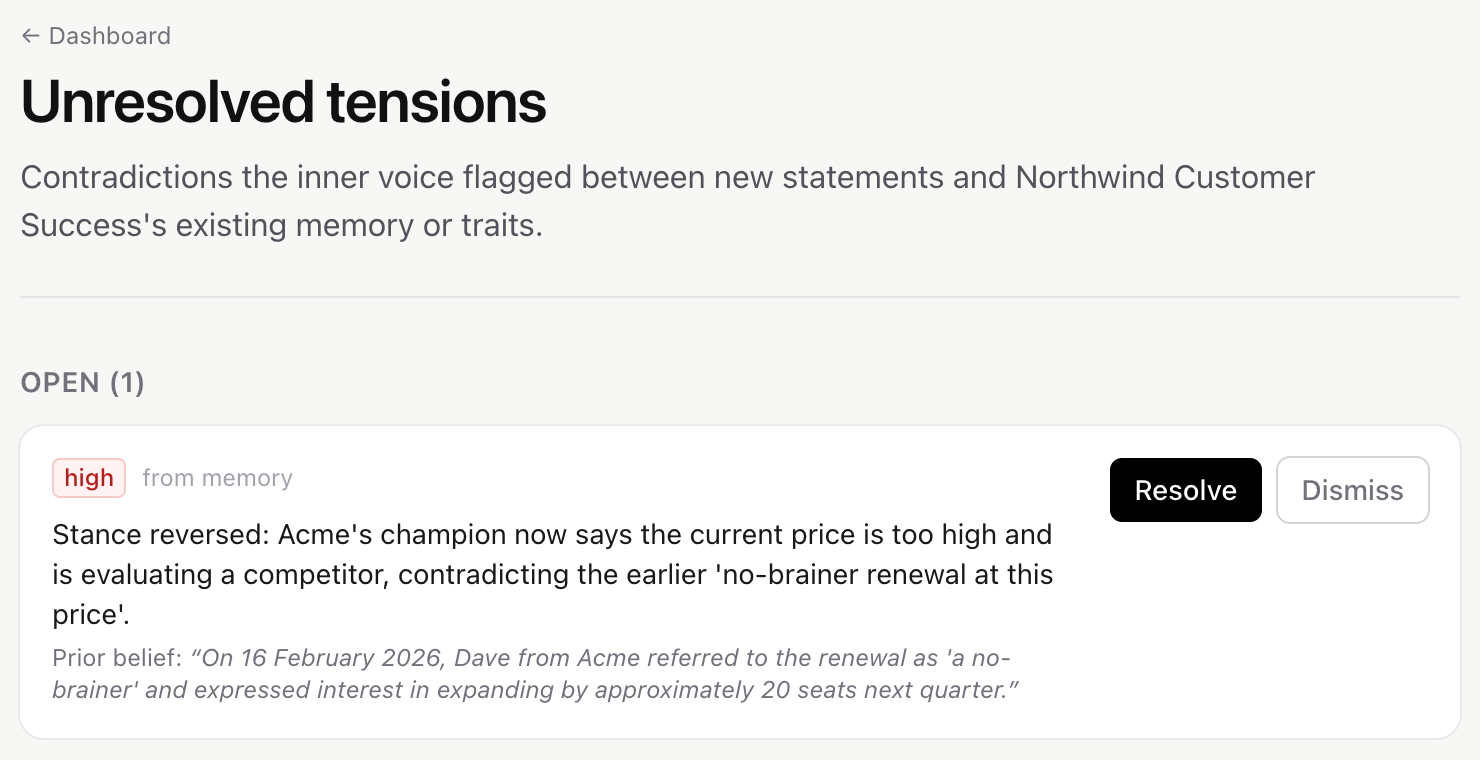
From a live workspace: the account's champion called the renewal “a no-brainer” in February. By June he was evaluating a competitor. MindTwin's inner voice connected the two statements months apart and raised the risk — before anyone asked.

MindTwin Unresolved tensions dashboard flagging a stance reversal on a renewal, with severity and the dated prior belief it contradicts

Actual dashboard — the tension MindTwin raised on its own, with the dated prior belief it contradicts. One click resolves it; the refuted belief then fades faster.

Download the product overview (PDF)

We also built and open-sourced TWIST — a benchmark for what memory benchmarks can't see: stance reversals, contradicting drafts, stale beliefs, unsafe recall.  Read the release →  ·  GitHub →

Four Cognitive Layers

MindTwin models the four layers of human cognition — from unconscious forgetting to the memories that define who you are.

🧠

The Subconscious

Biologically-inspired decay. Memories fade naturally based on frequency and recency — exactly like the Ebbinghaus forgetting curve.

🔍

The Conscious

Proprietary cognitive re-ranking goes beyond keyword search to model memory "liveness." Fresh, frequently accessed memories surface first.

💤

The Identity

Sleep cycle consolidation distills episodic memories into behavioral traits — the twin literally "dreams" to build its personality.

💎

The Heart

Flashbulb memories detected by the Salience Engine and validated by you. Core memories that never fade — your wedding, your first startup, your breakthroughs.

How It Works

Every message flows through a biologically-inspired cognitive pipeline.

1

Encode

Message converted to semantic representation

2

Search

Proprietary memory vault retrieval

3

Rerank

Cognitive activation scoring

4

Reinforce

Accessed memories strengthened

5

Generate

Streaming AI with personality

6

Store

New memory with salience metadata

System Architecture

Three-layer design: UI, Cognitive Engine, and Persistent Storage.

+--------------------------------------------------------------+ | Interactive UI Layer | | Chat (streaming) | Dashboard | Co-pilot Validation | +--------------------------------------------------------------+ | +--------------------------------------------------------------+ | Cognitive Engine | | | | Salience Cognitive Reflection Sleep Cycle | | Scorer Reranker Loop Consolidator | | (multi-signal (proprietary (self- (episodic -> | | detection) activation) critique) personality) | | | +--------------------------------------------------------------+ | +--------------------------------------------------------------+ | Persistent Vector Memory Vault | | | | Episodic Memories Semantic Traits Core (Flashbulb) | | (high decay) (low decay) (near-zero decay) | | | | Neural Embedding Layer | +--------------------------------------------------------------+ | Multi-Provider LLM Integration

The Science

Built on 50+ years of ACT-R cognitive architecture research.

Cognitive Activation Model

Based on ACT-R Theory

Our proprietary activation model, grounded in 50+ years of ACT-R cognitive architecture research, determines which memories surface. Frequently accessed, recent memories stay vivid. Unused ones fade — just like the human brain.

Salience Detection

Multi-Signal Scoring

Emotional intensity, explicit intent, and semantic novelty combine in a proprietary scoring model to automatically flag potential core memories for human validation.

Proven, Not Promised

Every claim below is checkable — the benchmark harness, methodology, and test suite ship with the product. The memory tools also run inside Claude and Claude Code today via MCP.

1,540
questions — evaluated on the full LoCoMo long-conversation memory benchmark, reproducible with one command
0
crisis false-positives from the safety gate across 5,882 emotionally varied conversation turns
180+
automated tests, including a mandatory cross-tenant isolation suite that gates every change

Frequently Asked Questions

What is MindTwin?

MindTwin is a shared cognitive memory for Customer Success teams. It connects to Slack, Gmail, and Gong, remembers every customer account, and flags renewal risk when a customer's stance changes — unprompted, with citations back to the source conversations.

How is MindTwin different from RAG or enterprise search tools?

Search and RAG tools retrieve what was said. MindTwin also notices when what is being said changes: its inner voice detects contradictions and stance reversals across months, vets outgoing drafts against the record before they're sent, and lets refuted beliefs fade via processing-aware decay.

Which tools does MindTwin connect to?

Slack, email (Gmail), and call transcripts (Gong). Memory is per-team, enforced with Postgres row-level security, so a team can only ever see its own memory.

Is customer data safe in MindTwin?

PII such as emails and phone numbers is redacted before anything is stored, crisis content is never stored (the bot responds with a helpline referral instead), and every suppression is auditable without storing content. In benchmark runs the safety gate produced zero false positives across 5,882 conversation turns.

What is the TWIST benchmark?

TWIST is an open benchmark created by MindTwin for the capabilities recall benchmarks cannot see: unprompted tension detection, draft alignment, belief supersession, and safe recall. It extends LoCoMo; the spec, dataset, and results are public at github.com/subratpanda/twist-benchmark.

How does a MindTwin pilot work?

Six weeks on one at-risk segment, fixed fee scoped on one call, one success metric agreed up front — for example, surface at least three at-risk renewals the team would have missed. You keep the findings either way.
Prove It on Your Data

Run a paid pilot on one at-risk segment: six weeks · fixed fee, scoped on one call · one success metric agreed up front (e.g. surface ≥3 at-risk renewals you'd have missed) · you keep the findings either way.

Start a 6-Week Pilot Product Overview (PDF)