The $20 Trillion Memory Problem: Why the SaaS-to-AI Migration Needs a Brain, Not Just a Database
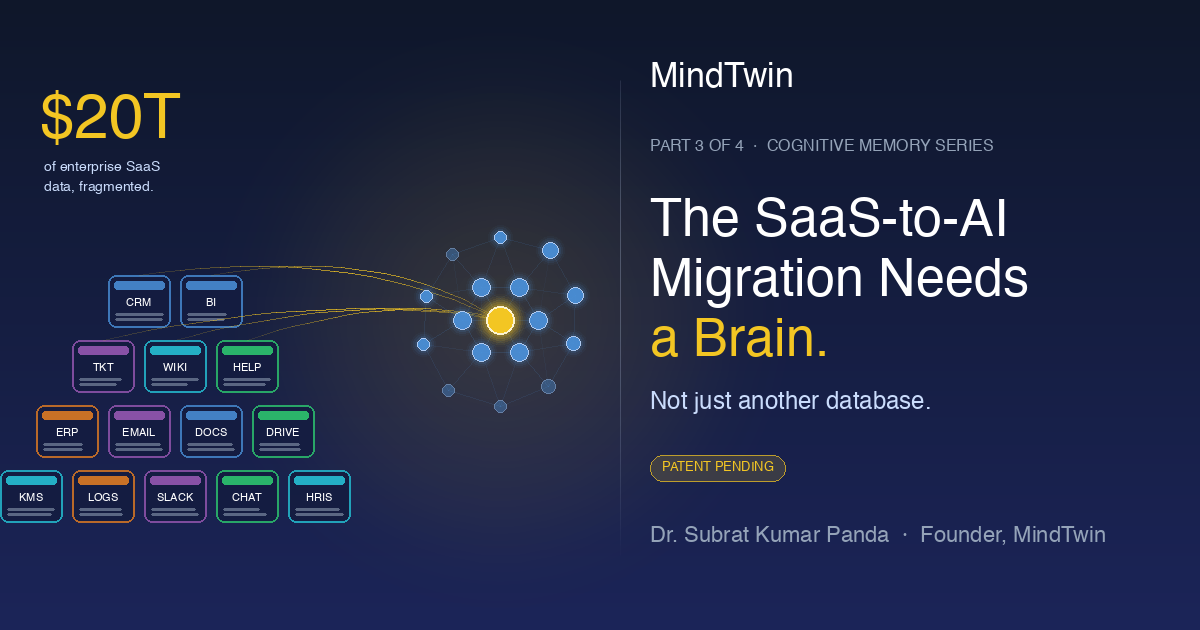
Two major publications argued this month that organizational memory is the bottleneck for enterprise AI. Neither proposed a technical solution. Here's ours.
Something interesting happened in March 2026. Within the same week, Forbes Technology Council published a piece arguing that organizational memory is the missing ingredient in enterprise AI, and Avataar Ventures published an investment thesis claiming the SaaS-to-AI migration will be defined by whoever captures the institutional knowledge trapped inside $20 trillion worth of enterprise software.
They're both saying the same thing from different angles. Forbes is saying it to CTOs. Avataar is saying it to investors. And they're both right.
But they're both stopping at the diagnosis without offering a cure.
The Diagnosis
Let's put the two arguments side by side.
Forbes says: AI systems fail in enterprises because the organizational knowledge feeding them is messy and inconsistent. The models are fine. The memory is broken. The fix? Better documentation habits and intentional knowledge preservation.
Avataar says: Twenty trillion dollars of enterprise SaaS contains institutional memory encoded in workflows, schemas, permissions, and integrations. AI doesn't replace this — it feeds on it. The opportunity? New infrastructure categories will emerge to bridge SaaS data into AI systems, the way Snowflake bridged databases into the cloud.
Both arguments land on the same truth: the hard problem of enterprise AI isn't intelligence. It's memory.
Your models can reason. Your vector databases can retrieve. Your RAG pipelines can ground responses in context. But none of that matters if the context itself is stale, contradictory, or buried in systems that nobody maintains.
Why the Current Solutions Won't Work
The Forbes article recommends better documentation practices and clearer knowledge-sharing habits. With respect — this is the equivalent of telling someone with a broken leg to walk more carefully. The problem isn't a lack of discipline. It's a lack of infrastructure.
Every enterprise has a wiki nobody updates. A Confluence space that's 60% outdated. A SharePoint folder structure that reflects an org chart from three reorganizations ago. These systems don't fail because people are lazy. They fail because they require continuous human effort to stay current, and humans have actual jobs to do.
The Avataar thesis is more sophisticated — it identifies the infrastructure gap. They predict new categories will emerge: vector databases, unstructured data processing, RAG systems, AI governance tools. But even this framing treats memory as a data problem. Store it better. Index it faster. Retrieve it more accurately.
That's necessary. But it's not sufficient.
Because the hardest part of organizational memory isn't storing what you know. It's knowing what still matters.
The Problem Nobody Is Solving
Here's a scenario every enterprise lives with:
Your AI assistant confidently recommends a procurement process that was abandoned eighteen months ago. Why? Because the documentation for that process still exists in your knowledge base. It was never deleted, never marked as deprecated. It sits there, fully indexed, perfectly retrievable, and completely wrong.
This is the fundamental failure mode of every knowledge management system ever built: they accumulate but never forget.
New information gets added. Old information stays. Nobody has time to review and prune. So the system grows — and as it grows, the ratio of current knowledge to stale knowledge gets worse and worse. Your AI becomes increasingly confident about things that are decreasingly true.
Now multiply this by every department, every process, every policy change, every reorg, across twenty years of accumulated enterprise SaaS data. That's the $20 trillion memory problem. And no amount of better indexing will fix it, because the data itself is the problem.
What If the System Knew How to Forget?
Your brain handles this exact problem, and it handles it effortlessly. You don't manually prune your memories. You don't run quarterly reviews of your knowledge base to check for accuracy. You just live your life, and your brain takes care of the rest.
It does this through three mechanisms that fifty years of cognitive science have documented in precise mathematical detail:
Decay. Every memory in your brain has an activation level that drops over time. Information you don't access fades. Information you access regularly stays sharp. This isn't data loss — it's intelligence. Your brain is continuously answering the question "what still matters?" based on the only signal that actually works: usage.
Consolidation. While you sleep, your brain reviews the day's experiences and extracts patterns. It doesn't store raw events forever — it compresses them into abstract knowledge. You don't remember every meal you've ever eaten, but you know what you like. The episodes fade. The wisdom persists.
Salience detection. Your amygdala monitors incoming experience for significance — emotional intensity, novelty, explicit importance markers. When it detects something that matters, it flags it for special treatment. These "flashbulb memories" get encoded more deeply and resist decay. Your brain knows the difference between a Tuesday afternoon meeting and the day you got acquired.
These aren't metaphors. They're mathematical functions, formalized in the ACT-R cognitive architecture over fifty years of peer-reviewed research. They describe exactly how human memory maintains relevance without manual curation.
And until now, nobody has applied them to enterprise knowledge systems.
Memory as Infrastructure
Avataar's thesis predicts that the SaaS-to-AI migration will create new infrastructure categories worth trillions. They draw a parallel to Snowflake — a company that emerged during the cloud migration by solving the data warehouse problem in a fundamentally new way.
We think the parallel is exact. And we think the category that's missing is cognitive memory infrastructure.
Not a database. Not a search engine. Not a RAG pipeline. A system that treats organizational knowledge the way your brain treats memory:
Knowledge that maintains itself. Capture it passively from how teams actually work. Let mathematical decay handle freshness. Information that's referenced regularly stays current. Information that's not fades below the retrieval threshold. No cleanup sprints. No documentation drives. No wiki gardening.
Wisdom that emerges automatically. Run consolidation cycles that analyze raw interactions and extract institutional patterns. Don't store that the team discussed database options for three hours on Tuesday. Store that the engineering culture favors proven tools over cutting-edge ones. The detail compresses. The insight persists.
Importance that's validated by humans. When the system detects something significant — a pivotal decision, a strategic shift, a hard-won lesson — flag it. Let a human confirm: yes, this is a core piece of who we are. Protect it permanently. Or no, let it fade. The system proposes. The human disposes.
This is what Avataar calls the "new infrastructure category." This is what Forbes calls "treating memory as an operational system." And this is what we've built.
The Snowflake Moment for Memory
When Snowflake launched, people asked: "Why do I need a new data warehouse? I have Oracle." The answer was that cloud-native data required cloud-native infrastructure. You couldn't just lift-and-shift your on-premise data warehouse and expect it to work in a world of elastic compute and infinite storage.
Enterprise AI is hitting the same wall. You can't just lift-and-shift your existing knowledge management into an AI system and expect it to work in a world of continuous learning and real-time context. The knowledge itself needs to be alive — growing, decaying, consolidating, and adapting.
The organizations that figure this out will have a compound advantage that grows over time. Every interaction makes their memory smarter. Every day of decay makes their context more relevant. Every consolidation cycle makes their institutional wisdom more refined. And every core memory their people validate makes their identity more defined.
The organizations that don't will keep building on top of stale wikis and outdated documentation, wondering why their AI keeps confidently recommending processes that were abandoned two years ago.
The Next Trillion-Dollar Infrastructure Layer
Forbes told the CTOs that organizational memory is broken. Avataar told the investors that fixing it is a trillion-dollar opportunity. We agree with both.
But the solution isn't better documentation habits. And it isn't just better databases. It's a fundamentally new kind of infrastructure — one that models knowledge the way the brain models memory. One that knows how to forget.
The SaaS-to-AI migration doesn't just need a warehouse for data. It needs a brain for memory. And brains don't just store. They decay, consolidate, detect significance, and protect what matters.
That's not a feature. That's a category.
The Cognitive Memory Series
- Part 1: Your AI Has Amnesia
- Part 2: Forbes and Organizational Memory
- → Part 3: The $20 Trillion Memory Problem (you are here)
- Part 4: Databricks and the Storage vs Cognition Divide
- Part 5: The Fourth Dimension