Forbes Says Enterprise AI Needs Organizational Memory. Here's Why It Also Needs to Forget.
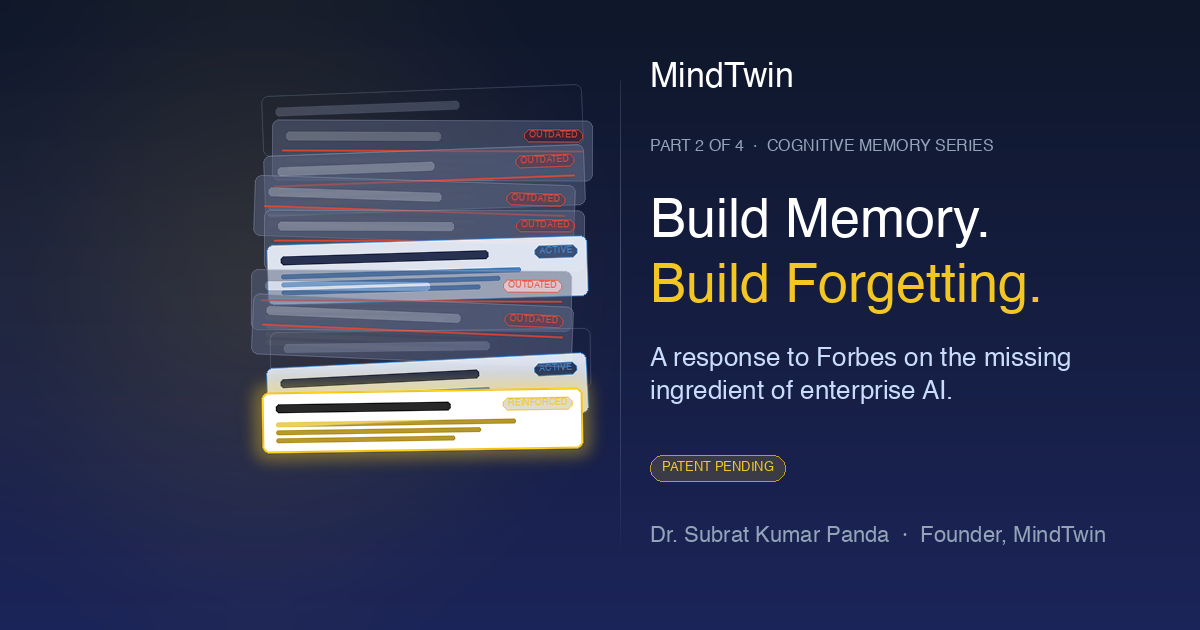
Last month, Forbes published an article arguing that organizational memory is the missing piece in enterprise AI. They're right about the problem. But the solution isn't what you think.
A few weeks ago, Dr. Kanishk Agrawal wrote a piece in Forbes Technology Council that stopped me mid-scroll. The title: "The Role Of Organizational Memory In Scaling Enterprise AI."
His argument was sharp: AI systems fail in enterprises not because the models are bad, but because the organizational knowledge feeding them is messy, inconsistent, and decaying. The models learn fast. The organizations learn slow. And the gap between those two speeds is where AI projects go to die.
He's absolutely right. But I think he stopped one step short of the real insight.
The article calls for better documentation practices, clearer knowledge-sharing habits, and intentional preservation of institutional memory. In other words: humans need to be more disciplined about organizing what they know.
Here's the problem with that: they won't be.
The Documentation Fantasy
Every organization I've ever worked with has the same story. There's a wiki. It was great for the first three months. Then people stopped updating it. Now it's 40% accurate, 30% outdated, and 30% actively misleading. Nobody trusts it. New hires learn to ignore it by week two.
This isn't a discipline problem. It's a design problem.
You're asking the busiest people in the organization — the ones with the most institutional knowledge — to stop doing their actual jobs and write down what they know. And then you're asking them to go back every quarter and update it. And then you're asking everyone else to trust that they did.
It doesn't work. It has never worked. And better AI tools won't make it work, because the bottleneck isn't technology. It's human behavior.
So what if the system didn't need humans to be disciplined at all?
What Your Brain Does That Your Wiki Doesn't
Your brain handles this problem effortlessly. You don't sit down every evening and update your mental documentation. You don't tag your memories with metadata or file them in the right folder. You just live, and your brain handles the rest.
How? Three mechanisms that no enterprise knowledge system has ever implemented:
1. Decay. Your brain continuously weakens memories that aren't reinforced. That meeting about the Q2 pricing strategy? If nobody referenced it again, it's gone in a month. But the architectural decision that gets discussed every sprint? Crystal clear. Your brain doesn't need someone to go through and delete outdated knowledge. It fades on its own.
2. Consolidation. Every night while you sleep, your brain takes the day's raw experiences and extracts patterns. It doesn't store "John said we should use Postgres at 2:47pm on Tuesday." It stores "the team prefers established, well-documented tools over cutting-edge ones." The detail compresses. The insight persists.
3. Salience detection. Your amygdala — a small almond-shaped structure in your temporal lobe — tags experiences with emotional significance before your conscious mind even processes them. This is why you remember where you were on September 11th but not what you had for lunch that day. Your brain has a built-in system for detecting what matters.
These three mechanisms — decay, consolidation, and salience — are what make human memory intelligent rather than just large. And they're exactly what's missing from every enterprise knowledge management system ever built.
Memory as Infrastructure, Not Habit
The Forbes article concludes with a quote from a global CIO: "The team began to view memory as an essential operational system after they realized it served more than its traditional role as a storage function."
This is exactly right. Memory isn't a storage function. It's an intelligence function. And intelligence functions shouldn't depend on human discipline — they should run as infrastructure.
What would that look like in practice?
Knowledge that maintains itself. Instead of asking people to update documentation, capture knowledge passively from how teams actually work — their conversations, their decisions, their patterns. Instead of manual curation, let mathematical decay handle freshness. Information that's referenced regularly stays current. Information that's not fades below the retrieval threshold. No cleanup sprints needed.
Wisdom that emerges automatically. Instead of hoping someone will write a post-mortem, run periodic consolidation cycles that analyze raw interactions and extract institutional patterns. "This team tends to over-engineer solutions when deadlines are tight." "This client responds best to data-driven arguments." These insights don't need to be documented. They need to be distilled.
Importance that's validated, not assumed. Instead of treating every piece of information equally, score it for significance. When the system detects something that breaks the existing pattern — a pivotal decision, a strategic shift, a lesson learned the hard way — flag it. Then let a human confirm: yes, this matters. Protect it. Or no, let it fade like everything else.
The Trust Problem, Solved Differently
The Forbes piece makes an excellent point about trust: "AI systems must earn user trust before people will use them." It argues that trust comes from grounding AI outputs in real operating context.
I'd add one thing: trust also comes from appropriate forgetting.
When an AI system surfaces a recommendation based on a process that was abandoned two years ago, trust evaporates instantly. Every enterprise knowledge system eventually poisons itself with stale information. The more data you accumulate, the more likely your AI is to confidently recommend something that's no longer true.
Mathematical decay solves this elegantly. Outdated processes that nobody references anymore naturally fall below the retrieval threshold. The system doesn't need someone to go through and mark them as deprecated. It just... forgets them. The way you forgot the name of the restaurant you went to once in 2019 but remember the one you go to every Friday.
That's not a bug. That's intelligence.
The Real Competitive Advantage
Forbes frames organizational memory as a leadership discipline. I'd reframe it as an engineering problem that we've finally developed the tools to solve.
The cognitive science has been there for decades. The ACT-R framework — Adaptive Control of Thought, Rational — has been modeling human memory mathematically since the 1970s. We know the equations. We know the decay curves. We know how salience detection works and how consolidation transforms episodic experience into semantic knowledge.
What's new is that we can now wire these mechanisms into AI systems that are powerful enough to use them meaningfully. We can build knowledge infrastructure that doesn't just store what an organization knows — it thinks about what it knows. It strengthens what matters, forgets what doesn't, consolidates experience into wisdom, and protects the defining moments that shaped the institution.
The organizations that figure this out first won't just have better AI. They'll have something no amount of documentation sprints can produce: a system that knows who they are.
The Cognitive Memory Series
- Part 1: Your AI Has Amnesia
- → Part 2: Forbes and Organizational Memory (you are here)
- Part 3: The $20 Trillion Memory Problem
- Part 4: Databricks and the Storage vs Cognition Divide
- Part 5: The Fourth Dimension